Push Bar Installation in Rolling Hills, CA
Push bars, panic bars, and crash bars installed on commercial doors — code-compliant exit devices fitted to the door, not forced onto it. Local technicians, free estimates, and same-day response in Rolling Hills.
A building's front door tells you everything about how seriously it takes security. At Access Controls LA, push bar installation in Rolling Hills isn't a side offering — it's the core of what our technicians train on, stock parts for, and stand behind. If you'd rather talk than read, (888) 897-8860 reaches our dispatch desk from early morning until late evening.
Push Bar Installation for Rolling Hills Properties
The properties we service in Rolling Hills share some clear patterns. Gated communities in and around Rolling Hills bring their own checklist — resident lanes that don't stack traffic, visitor entry that residents approve from a phone, and vendor windows the board can actually audit.
The larger lots and equestrian properties around Rolling Hills usually mean long driveways and remote gates, where solar power, wireless intercoms, and long-range readers solve what trenching can't.
Our Rolling Hills clients at the higher end of the market want security without visual clutter; we design systems that are felt, not seen.
We also keep notes on what we've installed around Rolling Hills — door types, common panel locations, the quirks of the local building vintages — so follow-up calls and new projects start ahead instead of from scratch.
What Separates Good Push Bar Installation From Guesswork
These aren't marketing points — they're the habits that keep our callback rate near zero. It matters that exit devices are life-safety hardware: rim, mortise, and vertical-rod devices each suit different doors and pairs, and the wrong type fails inspection. Experience shows up in details like this: the device is sized and cut to the door, with through-bolts and reinforcement where hollow metal or aluminum needs it. We make sure outside trim — lever, pull, or keyed — is chosen separately from the bar, which is how a door stays exit-always while entry stays controlled.
Done properly, electrified latch retraction or alarm kits can be built in from day one, or added later if the device is specified right. Before we call it finished, ADA requires exits to operate with a single motion and limited force, and we verify both with a gauge before handoff. You're paying a professional so that fire-rated openings require fire-exit hardware — a standard panic bar on a rated door voids its label.
The Situations We Fix Most
Here's what typically pushes a property from thinking about it to calling:
- An exit-only door that staff keep propping because it has no outside entry.
- A fire marshal citation for a missing or non-compliant exit device.
- A glass or aluminum storefront door that needs a code-legal exit.
- Double doors that need panic hardware without a center mullion.
None of these get better on their own — and each one has a known, fixable cause that a proper assessment will surface in minutes.
Where We Install It
We've installed this for just about every property type, though a few come up constantly — restaurants, schools, warehouses, office buildings, among others.
Different buildings stress hardware differently, so the same service can mean meaningfully different equipment choices from one property to the next. High-traffic entries also justify monitored hardware that reports its own health, so a weakening lock gets replaced on a schedule instead of failing at 8am.
Getting the Hardware Decision Right
Spec sheets won't tell you what matters here, because what matters is how your property operates at 7am on a Monday. A four-unit building, a 40-suite office, and a 400-resident tower can all be 'access control' and share almost no hardware in common. When the technology fits the property, the system disappears into the routine; when it doesn't, it becomes everyone's least favorite coworker.
Longevity comes from boring places: supervised power with batteries that get tested, conductors sized for the run, hardware rated for the environment it lives in. Ask any vendor one question: 'who else can service this?' The answer tells you whether you're buying a system or a dependency. Resist the urge to over-buy, too. Half our value on a survey is naming what a property doesn't need — features that demo well and then sit unused for a decade.
From First Call to Finished System
1. Walkthrough and Survey
A technician walks the property with you — every controlled opening, the door and frame materials, existing wiring, power availability, and network access. We photograph, measure, and note the things that bite installs later: fire-rated doors, ADA clearances, panel locations, cable paths. The survey is free, takes under an hour for most properties, and ends with you knowing what's actually feasible.
2. Scope, Spec, and Price
We design the system around how the property actually operates: who needs access, when, and through which doors. The proposal names exact hardware — not 'reader, qty 4' but the specific model and why. Options are priced as options, so good-better-best is your decision, made with real numbers.
3. The Install
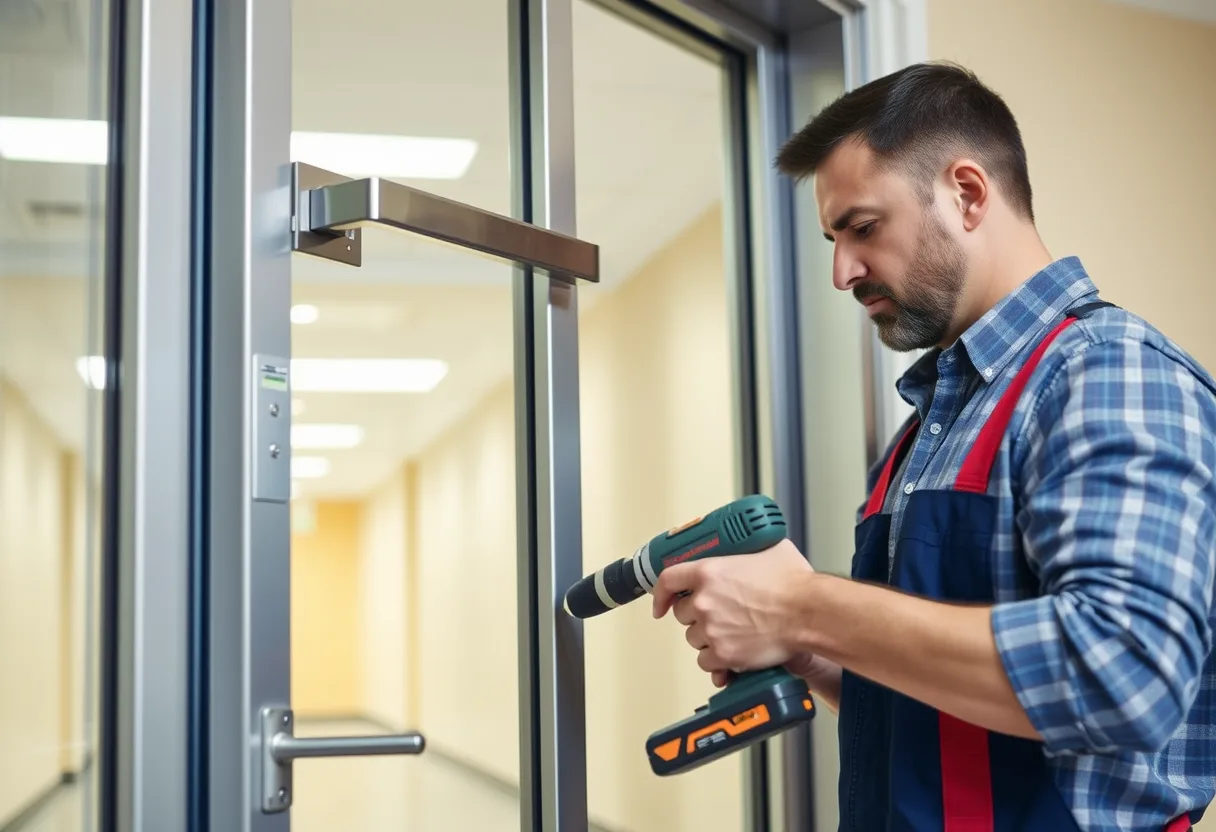
Installation is scheduled around your operation — occupied offices, tenant buildings, and storefronts each get a plan that keeps doors functional through the workday. Our technicians drill clean, pull and label every conductor, mount hardware level and square, and leave the site cleaner than they found it. No borrowed subcontractors; the people who quoted are the people who answer for the work.
4. Setup, Testing, and Handoff
Commissioning means testing every door the hard way: real credentials at the reader, lock engagement under load, request-to-exit timing, door position reporting, and alarm events confirmed end to end. Then we train your people — enrolling and revoking credentials, changing schedules, running reports — until they're comfortable driving the system themselves.
5. Ongoing Service
After the install, you have a direct line — (888) 897-8860 — to people who have your door schedule and as-builts on file, which turns most service calls into fast, surgical visits. Batteries, firmware, and credential audits can run on a schedule if you'd rather never think about the system at all.
Why Neighbors Keep Referring Us
Choosing an installer matters more than choosing a brand. A few reasons property owners across South Bay choose us:
- Repairs before replacements. If your existing system can be fixed economically, that's what we'll tell you — a reputation outlasts any single invoice.
- One accountable team. Survey, quote, install, program, and support come from the same company — no finger-pointing between a salesman, a sub, and a help desk.
- Fixed quotes that hold. The number we put in writing is the number on the invoice unless you change the scope.
- Specialists, not generalists. Access control, intercoms, buzzers, maglocks, and gates are all we do; we're not an alarm company moonlighting at your door hardware.
- Brand-agnostic advice. We install and service the major platforms, so the recommendation fits your building rather than a dealer quota.
We keep longer hours than nearly anyone in the trade: Sunday through Thursday 6:30am to 11:30pm and Friday 6:30am to 4pm. A door that fails at 9pm on a Tuesday doesn't wait for the next business day.
Cost Factors, Explained Plainly
Nobody can quote push bar installation in Rolling Hills accurately sight-unseen, and anyone who does is planning change orders. What we can do is tell you what moves the price.
- Door and frame construction — glass, aluminum storefront, hollow metal, and wood each take different locking hardware.
- The credential technology chosen, from basic keypads to encrypted cards to mobile.
- Code requirements at each opening — exit devices, fire alarm tie-ins, and ADA operators where applicable.
- The number of openings being controlled, since each door or gate carries its own hardware and labor.
- Site conditions like occupied spaces, after-hours work windows, lifts for high mounting, or trenching at gates.
After a walkthrough we quote one number, broken out by equipment and labor, and it holds. We'd rather lose a job on price than win it on surprises.
What People Type Before They Call
Property owners describe this need in wildly different words. These searches all land on the same answer:
- Fire door push bar
- Electric push bar installation
- Push bar with access control near me
- Alarmed panic bar installation
- Push bar installation cost
- Exit device installation near me
- Electric latch retraction push bar
- Crash bar for commercial door near me
Search engines treat those as different queries; our dispatch board treats them as Tuesday. One call to (888) 897-8860 covers every version of the problem.
What Happens When You Call
The call to (888) 897-8860 is shorter than you expect: what's the property, what's the door or gate doing, and when can we look at it. Describe what you're seeing in plain terms — 'the buzzer rings but the door won't open,' 'we need fobs for a new office,' 'the gate keypad died' — and we'll usually identify the likely cause and the fix on the spot.
No pressure tactics, no 'today-only' pricing — just a diagnosis, a number in writing, and a schedule that respects yours.
Beyond Rolling Hills
Rolling Hills is one stop on routes that also take us through Carson, El Segundo, Gardena, Hawthorne, Hermosa Beach, Inglewood — same technicians, same response standards, county-wide.
Push Bar Installation in Rolling Hills — FAQs
Can the system connect to my cameras or alarm?
How long does installation take?
What happens to the system when power fails?
Who actually shows up — employees or subs?
Is this legal for my doors? What about fire code?
Will my staff be able to add and remove users?
What areas do you serve?
How does scheduling work?
Can parts of my old system be kept?
Do you offer maintenance plans?
Push Bar Installation in Nearby Cities
More Services in Rolling Hills
- Magnetic Lock Installation Rolling Hills
- Magnetic Lock Repair Rolling Hills
- Magnetic Lock Replacement Rolling Hills
- Electric Strike Installation Rolling Hills
- Electrified Door Hardware Rolling Hills
- Push Bar Repair Rolling Hills
- Access Control Installation Rolling Hills
- Commercial Access Control Rolling Hills
- Key Card Entry Systems Rolling Hills
- Key Fob Entry Systems Rolling Hills
- Keypad Entry Systems Rolling Hills
- Mobile Access Control Rolling Hills
Push Bar Installation in Rolling Hills — Handled
Call (888) 897-8860 for a free on-site estimate anywhere in Rolling Hills.