
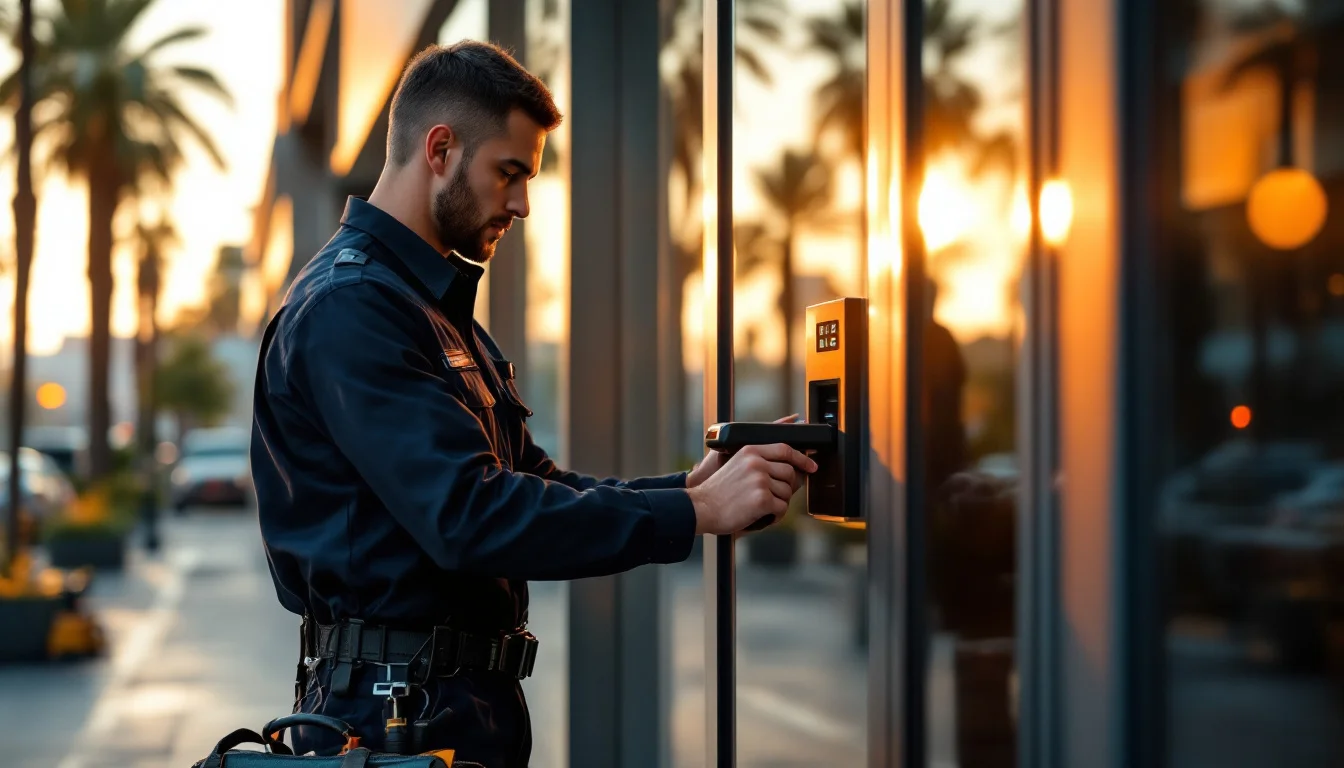
Access Control for Commercial Buildings & Offices
Access control, intercoms, and keyless entry for office buildings, suites, and commercial properties.
There's a moment every property owner recognizes: the day they stop trusting who might still have a key. Access Controls LA handles access control for commercial buildings & offices end to end — survey, hardware, wiring, programming, and the follow-up support that keeps it working. If you'd rather talk than read, (888) 897-8860 reaches our dispatch desk from early morning until late evening.
What Commercial Buildings & Offices Need From Access Control
These aren't marketing points — they're the habits that keep our callback rate near zero.
- Tenant turnover handled in software, not with a locksmith.
- Schedules that open lobbies by day and secure them at night.
- Suite-by-suite credentials with building-level common door access.
- Audit trails for after-hours entry.
Why Property Owners Call Us
Here's what typically pushes a property from thinking about it to calling:
- Tenant improvement churn breaking door hardware.
- Shared conference floors with no access logic.
- Master keys that have multiplied for years.
None of these get better on their own — and each one has a known, fixable cause that a proper assessment will surface in minutes.
The systems doing that work span our whole catalog: buzzer system repair, electric strike installation, push bar repair, push bar installation, residential access control — specified per property, never from a template.
How Engagements Usually Run
These engagements tend to begin the same way: someone responsible for the building decides the current entry situation has cost them one headache too many. We then translate that reality into a door-by-door design, put one number on it in writing, and schedule installation around the property's rhythm.
After cutover, administrators get trained until they're self-sufficient, documentation stays on site, and our service desk keeps the system's records for the day something needs attention. For decision-makers answering to others — boards, owners, regional managers — we provide the artifacts that make approval easy: itemized scopes, option pricing, insurance certificates, and references from similar properties.
Budget cycles matter too; phased proposals let a property fix the urgent doors this quarter and plan the rest without redesigning anything later.
Choosing the Right Technology
Buyers tend to start with the gadget and work backward; installers who know better start with the opening and the people using it. What decides the spec is duty cycle, weather exposure, door construction, and who answers when something goes wrong — not the brochure. Our job in the design phase is translating those realities into equipment — and being accountable for the translation years later.
A decade of reliable service is designed in at the start, in choices that never show up in a photo. Open standards matter too: systems built on common credential formats and standard wiring can be extended and serviced by anyone competent, not just the original vendor. One more lens worth applying: total cost over ten years, not the install invoice. Licensing, batteries, credential replacement, and service availability dwarf small hardware price differences over a system's life.
How the Work Unfolds
1. Site Survey & Assessment
Everything starts with eyes on the property. We check each opening's construction, trace what wiring already exists, verify power and network availability, and flag code considerations like egress requirements before anyone talks hardware. You get honest answers on site — including, sometimes, that you need less than you expected.
2. Scope, Spec, and Price
You receive a written scope with specific hardware models, labor, and programming — one number, no allowances that balloon later. We explain why each component was chosen and what the alternatives would save or cost. The quote holds unless the scope changes, and you'll never learn about an exclusion after the deposit.
3. Clean, Scheduled Installation
Installation is scheduled around your operation — occupied offices, tenant buildings, and storefronts each get a plan that keeps doors functional through the workday. Our technicians drill clean, pull and label every conductor, mount hardware level and square, and leave the site cleaner than they found it. No borrowed subcontractors; the people who quoted are the people who answer for the work.
4. Setup, Testing, and Handoff
The handoff is where many installers vanish; it's where we slow down. We commission door by door, tune alarm thresholds so staff don't learn to ignore them, and set up your administrators with their own logins and a cheat sheet for the five tasks they'll actually do. You shouldn't need us to add a new hire.
5. What Happens After We Leave
After the install, you have a direct line — (888) 897-8860 — to people who have your door schedule and as-builts on file, which turns most service calls into fast, surgical visits. Batteries, firmware, and credential audits can run on a schedule if you'd rather never think about the system at all.
What Makes Us Different
Choosing an installer matters more than choosing a brand. A few reasons property owners across Los Angeles County choose us:
- Local and present. We're based at 6100 Sepulveda Blvd in Van Nuys and work Los Angeles County daily — when something fails, the technician isn't driving in from another county.
- Brand-agnostic advice. We install and service the major platforms, so the recommendation fits your building rather than a dealer quota.
- Documentation left behind. Labeled wiring, panel maps, and credentials records stay with the property — you're never hostage to whoever installed the system.
- Fixed quotes that hold. The number we put in writing is the number on the invoice unless you change the scope.
- Specialists, not generalists. Access control, intercoms, buzzers, maglocks, and gates are all we do; we're not an alarm company moonlighting at your door hardware.
We keep longer hours than nearly anyone in the trade: Sunday through Thursday 6:30am to 11:30pm and Friday 6:30am to 4pm. A door that fails at 9pm on a Tuesday doesn't wait for the next business day.
Pricing: What Actually Moves the Number
Pricing for access control for commercial buildings & offices isn't a mystery — it's arithmetic driven by a handful of site factors.
- Software and licensing, which ranges from none (standalone) to per-door cloud subscriptions.
- Code requirements at each opening — exit devices, fire alarm tie-ins, and ADA operators where applicable.
- Door and frame construction — glass, aluminum storefront, hollow metal, and wood each take different locking hardware.
- Site conditions like occupied spaces, after-hours work windows, lifts for high mounting, or trenching at gates.
- The number of openings being controlled, since each door or gate carries its own hardware and labor.
After a walkthrough we quote one number, broken out by equipment and labor, and it holds. We'd rather lose a job on price than win it on surprises.
The Searches That Lead Here
The phone rings from all of these searches — different words, identical job:
- Office access control installation
- Commercial access control systems
- Office building access control — Los Angeles County
- Commercial building access control
Search engines treat those as different queries; our dispatch board treats them as Tuesday. One call to (888) 897-8860 covers every version of the problem.
Your First Call, Demystified
The call to (888) 897-8860 is shorter than you expect: what's the property, what's the door or gate doing, and when can we look at it. Describe what you're seeing in plain terms — 'the buzzer rings but the door won't open,' 'we need fobs for a new office,' 'the gate keypad died' — and we'll usually identify the likely cause and the fix on the spot.
From there it's a confirmed window, a technician who shows up inside it, and a written outcome: either the fix completed or a fixed quote for the work.
Where We Work
Our trucks dispatch daily from Van Nuys and run routes through every region of Los Angeles County — the San Fernando Valley, the Westside, South Bay, the San Gabriel Valley, the Gateway Cities, Santa Clarita, the Antelope Valley, and the neighborhoods between them.
Distance never changes the price list, and there's no 'extended service area' surcharge. If the property sits in Los Angeles County, it's regular territory and quoted like it.
Commercial Buildings & Offices FAQs
What brands do you install and service?
What's your response time in Los Angeles?
Can I manage it myself after you leave?
Are you licensed and insured?
Do you cover all of Los Angeles County?
Does this integrate with other building systems?
How disruptive is the install?
How does scheduling work?
Do you offer maintenance plans?
Can you work on a system another company installed?
Services These Properties Use Most
- Access Control Installation
- Commercial Access Control
- Key Card Entry Systems
- Key Fob Entry Systems
- Keypad Entry Systems
- Mobile Access Control
- Cloud-Based Access Control
- Biometric Access Control
- Residential Access Control
- Intercom Installation
- Video Intercom Systems
- Apartment Intercom Systems
- Telephone Entry Systems
- Gate Intercom Systems
- Buzzer System Installation
- Buzzer System Repair
Where We Work
- Access Control Arleta
- Access Control Burbank
- Access Control Calabasas
- Access Control Canoga Park
- Access Control Chatsworth
- Access Control Encino
- Access Control Glendale
- Access Control Granada Hills
- Access Control Hidden Hills
- Access Control Lake Balboa
- Access Control Lake View Terrace
- Access Control Mission Hills
- Access Control North Hills
- Access Control North Hollywood
- Access Control Northridge
Secure Your Commercial Buildings & Office Property
Free assessments across LA County — call (888) 897-8860.