Push Bar Installation in Lomita, CA
Push bars, panic bars, and crash bars installed on commercial doors — code-compliant exit devices fitted to the door, not forced onto it. Local technicians, free estimates, and same-day response in Lomita.
A building's front door tells you everything about how seriously it takes security. That's exactly the work Access Controls LA does: professional push bar installation in Lomita, engineered for the property in front of us rather than copied from the last job. Call (888) 897-8860 and a real technician — not a call center — will talk through your doors, your gates, and what they actually need.
Push Bar Installation for Lomita Properties
Working across Lomita has taught us what the local building stock actually demands. In Lomita's neighborhoods, the right system is usually simple — a keypad or smart credential at the doors that matter, installed cleanly and explained properly.
Storefronts in Lomita typically want two things at once: a welcoming front door during hours and an entry that locks down to buzz-in the moment staffing gets thin.
Beyond the property mix, geography shapes the work: Lomita sits within South Bay, which means our crews are already routed through the area daily — there's no 'trip charge' territory in Los Angeles County, and no learning curve about local building stock.
We also keep notes on what we've installed around Lomita — door types, common panel locations, the quirks of the local building vintages — so follow-up calls and new projects start ahead instead of from scratch.
What Professional Push Bar Installation Involves
The gap between a system that works for a decade and one that nags you monthly comes down to installation discipline. Part of our discipline: exit devices are life-safety hardware: rim, mortise, and vertical-rod devices each suit different doors and pairs, and the wrong type fails inspection. Done properly, electrified latch retraction or alarm kits can be built in from day one, or added later if the device is specified right. It matters that fire-rated openings require fire-exit hardware — a standard panic bar on a rated door voids its label.
Part of our discipline: ADA requires exits to operate with a single motion and limited force, and we verify both with a gauge before handoff. Across hundreds of installs, one rule holds: outside trim — lever, pull, or keyed — is chosen separately from the bar, which is how a door stays exit-always while entry stays controlled. It matters that the device is sized and cut to the door, with through-bolts and reinforcement where hollow metal or aluminum needs it.
Problems This Solves
These are the scenarios that fill our schedule:
- A glass or aluminum storefront door that needs a code-legal exit.
- An exit-only door that staff keep propping because it has no outside entry.
- A fire marshal citation for a missing or non-compliant exit device.
- Double doors that need panic hardware without a center mullion.
We've resolved each of these situations more times than we can count, and the diagnosis is usually quicker than the customer expects.
Common Applications
The usual homes for this hardware: warehouses, schools, restaurants, churches.
The property dictates the hardware, never the other way around; what we install at an office entry is not what we bolt to a yard gate. High-traffic entries also justify monitored hardware that reports its own health, so a weakening lock gets replaced on a schedule instead of failing at 8am.
Getting the Hardware Decision Right
Spec sheets won't tell you what matters here, because what matters is how your property operates at 7am on a Monday. A four-unit building, a 40-suite office, and a 400-resident tower can all be 'access control' and share almost no hardware in common. That's why our quotes name exact models with reasons attached, and why we'll talk you out of hardware you don't need as readily as we'll recommend what you do.
Most premature failures we're called to fix trace to one of three sins — undersized power, unsealed exterior hardware, or wiring that was never labeled. We favor equipment with a long parts tail and an open ecosystem, because the cheapest proprietary system becomes the most expensive one the day its manufacturer loses interest. It's also fair to ask how a system fails: well-designed entries degrade gracefully — doors stay secure, people stay safe, and the fix is a part, not a forklift.
How the Work Unfolds
1. The Assessment Visit
Everything starts with eyes on the property. We check each opening's construction, trace what wiring already exists, verify power and network availability, and flag code considerations like egress requirements before anyone talks hardware. You get honest answers on site — including, sometimes, that you need less than you expected.
2. Design & Fixed Quote
We design the system around how the property actually operates: who needs access, when, and through which doors. The proposal names exact hardware — not 'reader, qty 4' but the specific model and why. Options are priced as options, so good-better-best is your decision, made with real numbers.
3. Installation
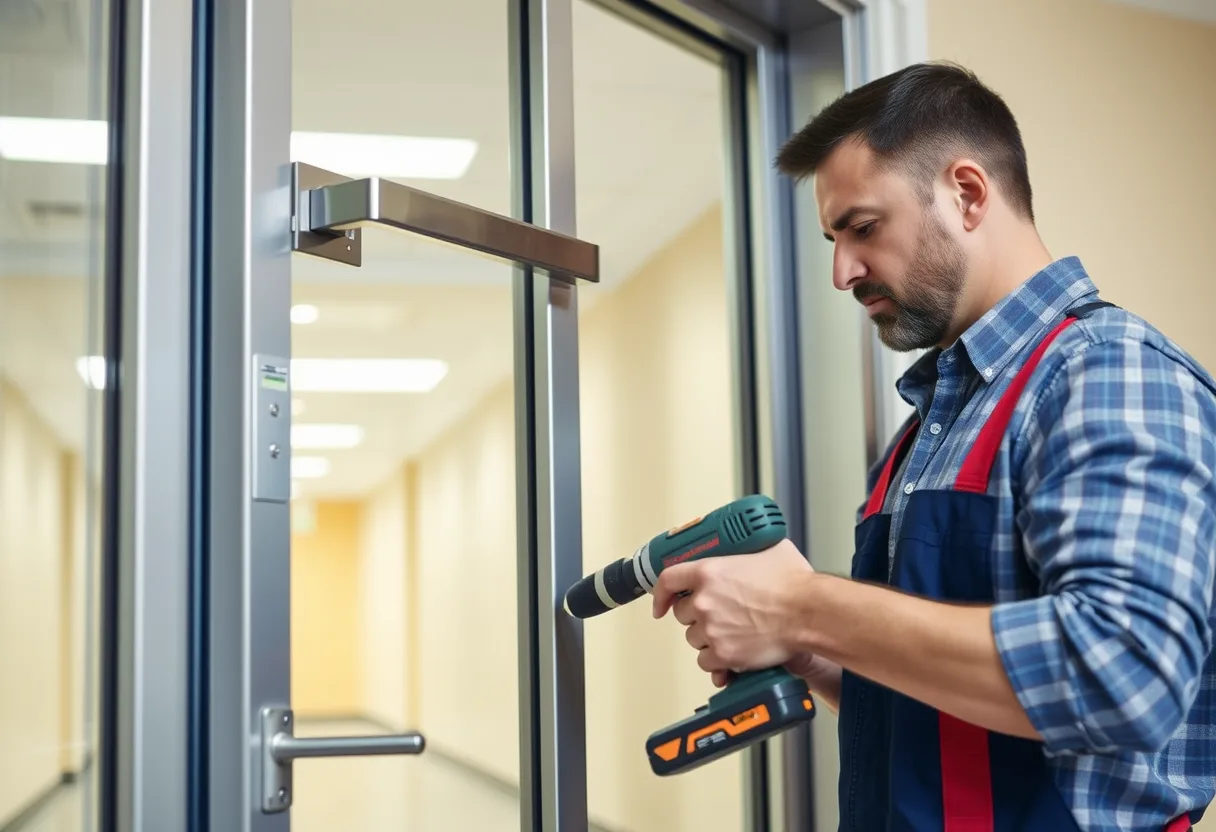
Installation is scheduled around your operation — occupied offices, tenant buildings, and storefronts each get a plan that keeps doors functional through the workday. Our technicians drill clean, pull and label every conductor, mount hardware level and square, and leave the site cleaner than they found it. No borrowed subcontractors; the people who quoted are the people who answer for the work.
4. Setup, Testing, and Handoff
Before we call a job done, each opening passes a functional checklist: valid credential admits, invalid denies, egress is instant, propped and forced events report correctly. Schedules, holidays, and access levels get built with you at the keyboard so the logic matches reality. Documentation and as-builts stay on site.
5. What Happens After We Leave
Systems live for years, and so does our relationship with them. We answer service calls for what we installed with real urgency — a locked-out business or a non-secure door is a same-day problem. Maintenance plans with scheduled testing, battery replacement, and firmware updates are available for properties that want failures caught before they happen.
The Case for Calling Us First
There's no shortage of companies that will sell you hardware. Here's what you actually hire when you call us:
- One accountable team. Survey, quote, install, program, and support come from the same company — no finger-pointing between a salesman, a sub, and a help desk.
- Long hours, real humans. The phone at (888) 897-8860 is answered Sunday through Thursday 6:30am to 11:30pm and Friday until 4pm — by dispatchers who schedule, not a voicemail tree.
- Local and present. We're based at 6100 Sepulveda Blvd in Van Nuys and work South Bay daily — when something fails, the technician isn't driving in from another county.
- Clean work, occupied buildings. Our crews are used to working around tenants, patients, and customers without turning your lobby into a construction site.
- Repairs before replacements. If your existing system can be fixed economically, that's what we'll tell you — a reputation outlasts any single invoice.
Our schedule is built around the reality that entries fail at inconvenient times — reach us Sunday–Thursday from 6:30am to 11:30pm, and Fridays until 4pm.
What It Costs — Honestly
We publish no fake 'starting at' teaser prices for push bar installation in Lomita; we'd rather explain the real drivers and then put a fixed number in writing after a survey.
- Whether existing cabling and hardware can be reused after testing.
- Code requirements at each opening — exit devices, fire alarm tie-ins, and ADA operators where applicable.
- Door and frame construction — glass, aluminum storefront, hollow metal, and wood each take different locking hardware.
- The credential technology chosen, from basic keypads to encrypted cards to mobile.
- The number of openings being controlled, since each door or gate carries its own hardware and labor.
The honest path is a short site visit, after which the quote is fixed and itemized. If a cheaper configuration would serve you fine, the quote will say so.
One Service, Many Search Terms
If any of these phrases brought you here, you're in the right place:
- Commercial push bar door installation
- Panic bar installation in Lomita
- Fire exit hardware installation (Lomita, CA)
- Crash bar installation — South Bay
- Push bar installation in Lomita
- Commercial push bar door installation
- Alarmed panic bar installation in Lomita
- Electric latch retraction push bar (Lomita, CA)
Search engines treat those as different queries; our dispatch board treats them as Tuesday. One call to (888) 897-8860 covers every version of the problem.
Your First Call, Demystified
When you dial (888) 897-8860, you're talking to the same local operation that will send the technician — no national call center, no lead reselling. Describe what you're seeing in plain terms — 'the buzzer rings but the door won't open,' 'we need fobs for a new office,' 'the gate keypad died' — and we'll usually identify the likely cause and the fix on the spot.
From there it's a confirmed window, a technician who shows up inside it, and a written outcome: either the fix completed or a fixed quote for the work.
Also Serving the Area Around Lomita
If your property sits outside Lomita proper, you're still covered: we regularly serve Carson, El Segundo, Gardena, Hawthorne, Hermosa Beach, Inglewood, and the rest of South Bay.
Push Bar Installation in Lomita — FAQs
How fast can you get to Lomita for push bar installation?
Can parts of my old system be kept?
How disruptive is the install?
Does this integrate with other building systems?
Is this legal for my doors? What about fire code?
Will the doors still work during a power outage?
How does scheduling work?
Are you tied to one manufacturer?
What ongoing support is available?
Is my aging system worth fixing?
Push Bar Installation in Nearby Cities
More Services in Lomita
- Magnetic Lock Installation Lomita
- Magnetic Lock Repair Lomita
- Magnetic Lock Replacement Lomita
- Electric Strike Installation Lomita
- Electrified Door Hardware Lomita
- Push Bar Repair Lomita
- Access Control Installation Lomita
- Commercial Access Control Lomita
- Key Card Entry Systems Lomita
- Key Fob Entry Systems Lomita
- Keypad Entry Systems Lomita
- Mobile Access Control Lomita
Push Bar Installation in Lomita — Handled
Call (888) 897-8860 for a free on-site estimate anywhere in Lomita.