Push Bar Installation in Los Angeles, CA
Push bars, panic bars, and crash bars installed on commercial doors — code-compliant exit devices fitted to the door, not forced onto it. Local technicians, free estimates, and same-day response in Los Angeles.
Security that depends on everyone remembering to lock up isn't security — it's luck. Access Controls LA specializes in push bar installation in Los Angeles, pairing commercial-grade hardware with installers who sweat the details most companies skip. Dial (888) 897-8860 and describe the entry; we'll usually know the fix, the hardware, and the ballpark before the call ends.
Push Bar Installation for Los Angeles Properties
Local conditions shape every spec we write in Los Angeles. The office suites and commercial corridors in Los Angeles run on tenant turnover, after-hours cleaning crews, and vendors who all need different levels of access — exactly the problem electronic credentials were built to solve.
The denser blocks of Los Angeles mean mixed-use buildings, shared lobbies, and parking structures — systems here coordinate several entry types under one credential database.
In Los Angeles's apartment stock, the intercom panel and the lobby door take more abuse than any other hardware on the property; we install equipment rated for exactly that duty.
We also keep notes on what we've installed around Los Angeles — door types, common panel locations, the quirks of the local building vintages — so follow-up calls and new projects start ahead instead of from scratch.
Inside a Proper Push Bar Installation Job
The gap between a system that works for a decade and one that nags you monthly comes down to installation discipline. You're paying a professional so that outside trim — lever, pull, or keyed — is chosen separately from the bar, which is how a door stays exit-always while entry stays controlled. Done properly, ADA requires exits to operate with a single motion and limited force, and we verify both with a gauge before handoff. Our technicians see to it that exit devices are life-safety hardware: rim, mortise, and vertical-rod devices each suit different doors and pairs, and the wrong type fails inspection.
Experience shows up in details like this: fire-rated openings require fire-exit hardware — a standard panic bar on a rated door voids its label. Our technicians see to it that electrified latch retraction or alarm kits can be built in from day one, or added later if the device is specified right. Non-negotiable for us: the device is sized and cut to the door, with through-bolts and reinforcement where hollow metal or aluminum needs it.
Sound Familiar? You're Not Alone
The calls we get about this tend to rhyme. A few of the most common:
- A fire marshal citation for a missing or non-compliant exit device.
- A glass or aluminum storefront door that needs a code-legal exit.
- Double doors that need panic hardware without a center mullion.
- An exit-only door that staff keep propping because it has no outside entry.
Every one of these has a hardware answer that costs less than living with the problem for another year.
Where We Install It
Across Central Los Angeles, this most often goes into schools, assembly spaces, warehouses, office buildings.
Each environment changes the spec — mounting heights, weather exposure, door materials, traffic volume — which is exactly why we survey before we quote. High-traffic entries also justify monitored hardware that reports its own health, so a weakening lock gets replaced on a schedule instead of failing at 8am.
Getting the Hardware Decision Right
Spec sheets won't tell you what matters here, because what matters is how your property operates at 7am on a Monday. A four-unit building, a 40-suite office, and a 400-resident tower can all be 'access control' and share almost no hardware in common. That's why our quotes name exact models with reasons attached, and why we'll talk you out of hardware you don't need as readily as we'll recommend what you do.
Longevity comes from boring places: supervised power with batteries that get tested, conductors sized for the run, hardware rated for the environment it lives in. We favor equipment with a long parts tail and an open ecosystem, because the cheapest proprietary system becomes the most expensive one the day its manufacturer loses interest. And think in phases — a system designed with spare panel capacity and standard wiring can add doors, upgrade credentials, and bolt on integrations later without starting over.
What Working With Us Looks Like
1. The Assessment Visit
First visit is diagnostic, not sales. We inspect the doors and gates in question, test any existing equipment worth saving, and map cable paths and panel locations. By the end of the walkthrough you'll know the realistic options, roughly what each costs, and which one we'd choose if it were our building.
2. Scope, Spec, and Price
We design the system around how the property actually operates: who needs access, when, and through which doors. The proposal names exact hardware — not 'reader, qty 4' but the specific model and why. Options are priced as options, so good-better-best is your decision, made with real numbers.
3. The Install
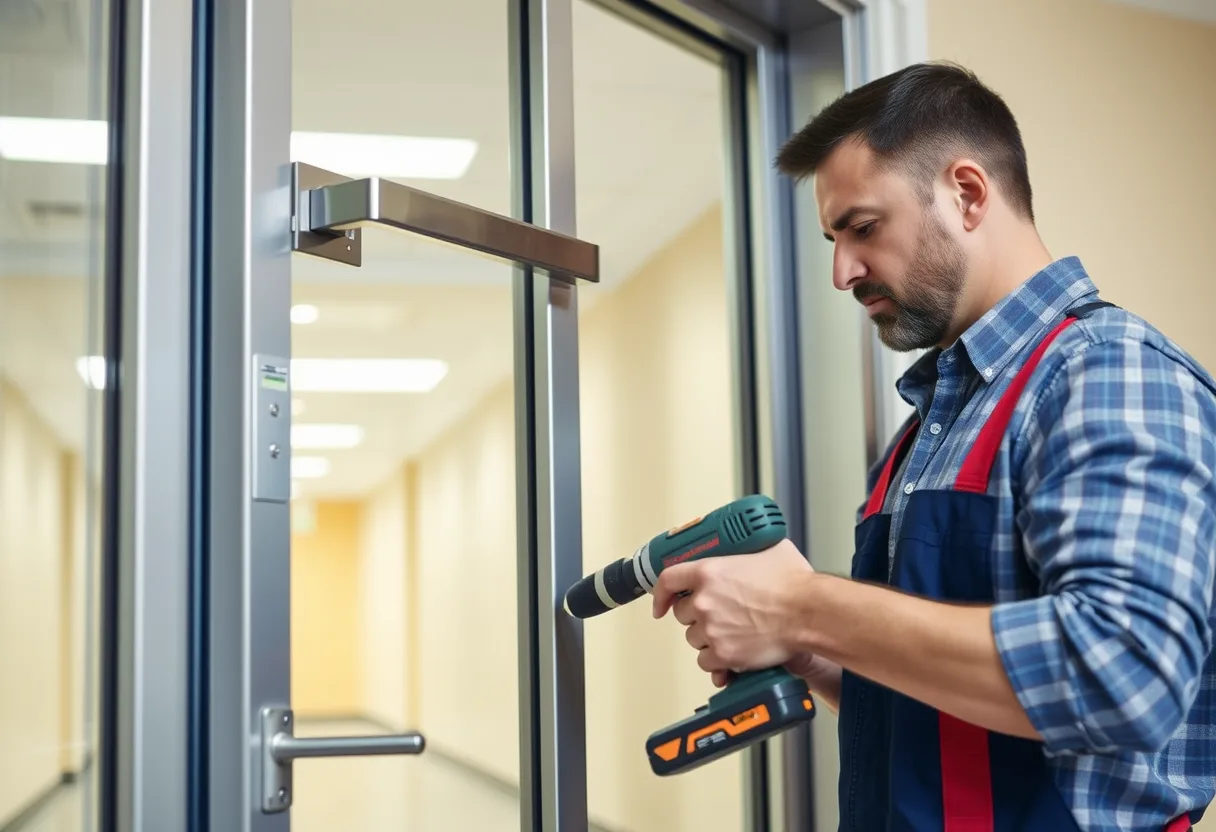
Installation is scheduled around your operation — occupied offices, tenant buildings, and storefronts each get a plan that keeps doors functional through the workday. Our technicians drill clean, pull and label every conductor, mount hardware level and square, and leave the site cleaner than they found it. No borrowed subcontractors; the people who quoted are the people who answer for the work.
4. Setup, Testing, and Handoff
The handoff is where many installers vanish; it's where we slow down. We commission door by door, tune alarm thresholds so staff don't learn to ignore them, and set up your administrators with their own logins and a cheat sheet for the five tasks they'll actually do. You shouldn't need us to add a new hire.
5. What Happens After We Leave
After the install, you have a direct line — (888) 897-8860 — to people who have your door schedule and as-builts on file, which turns most service calls into fast, surgical visits. Batteries, firmware, and credential audits can run on a schedule if you'd rather never think about the system at all.
The Case for Calling Us First
After years of fixing other companies' installs, we built ours around a few commitments:
- Clean work, occupied buildings. Our crews are used to working around tenants, patients, and customers without turning your lobby into a construction site.
- Specialists, not generalists. Access control, intercoms, buzzers, maglocks, and gates are all we do; we're not an alarm company moonlighting at your door hardware.
- Fixed quotes that hold. The number we put in writing is the number on the invoice unless you change the scope.
- Brand-agnostic advice. We install and service the major platforms, so the recommendation fits your building rather than a dealer quota.
- Documentation left behind. Labeled wiring, panel maps, and credentials records stay with the property — you're never hostage to whoever installed the system.
We keep longer hours than nearly anyone in the trade: Sunday through Thursday 6:30am to 11:30pm and Friday 6:30am to 4pm. A door that fails at 9pm on a Tuesday doesn't wait for the next business day.
Pricing: What Actually Moves the Number
Nobody can quote push bar installation in Los Angeles accurately sight-unseen, and anyone who does is planning change orders. What we can do is tell you what moves the price.
- Wiring distance and pathway difficulty between doors, panels, and power.
- Door and frame construction — glass, aluminum storefront, hollow metal, and wood each take different locking hardware.
- The credential technology chosen, from basic keypads to encrypted cards to mobile.
- Software and licensing, which ranges from none (standalone) to per-door cloud subscriptions.
- Code requirements at each opening — exit devices, fire alarm tie-ins, and ADA operators where applicable.
The honest path is a short site visit, after which the quote is fixed and itemized. If a cheaper configuration would serve you fine, the quote will say so.
What People Type Before They Call
Property owners describe this need in wildly different words. These searches all land on the same answer:
- Crash bar for commercial door near me
- Push bar installation cost
- Crash bar installation in Los Angeles
- Push bar with access control
- Push bar installation (Los Angeles, CA)
- Commercial push bar door installation — Central Los Angeles
- Commercial panic bar installation — Central Los Angeles
- Fire door push bar — Central Los Angeles
However the search was worded, the destination is the same: a licensed local crew that does this exact work daily across Central Los Angeles, reachable at (888) 897-8860.
Your First Call, Demystified
When you dial (888) 897-8860, you're talking to the same local operation that will send the technician — no national call center, no lead reselling. Describe what you're seeing in plain terms — 'the buzzer rings but the door won't open,' 'we need fobs for a new office,' 'the gate keypad died' — and we'll usually identify the likely cause and the fix on the spot.
From there it's a confirmed window, a technician who shows up inside it, and a written outcome: either the fix completed or a fixed quote for the work.
Also Serving the Area Around Los Angeles
Los Angeles is one stop on routes that also take us through West Hollywood, Baldwin Hills, Chinatown, Crenshaw, Downtown Los Angeles, East Hollywood — same technicians, same response standards, county-wide.
Push Bar Installation in Los Angeles — FAQs
Do maglocks and controlled doors meet code?
Does this integrate with other building systems?
Are you tied to one manufacturer?
What areas do you serve?
Will the doors still work during a power outage?
How does scheduling work?
Who actually shows up — employees or subs?
What ongoing support is available?
Can parts of my old system be kept?
How long does installation take?
Push Bar Installation in Nearby Cities
More Services in Los Angeles
- Magnetic Lock Installation Los Angeles
- Magnetic Lock Repair Los Angeles
- Magnetic Lock Replacement Los Angeles
- Electric Strike Installation Los Angeles
- Electrified Door Hardware Los Angeles
- Push Bar Repair Los Angeles
- Access Control Installation Los Angeles
- Commercial Access Control Los Angeles
- Key Card Entry Systems Los Angeles
- Key Fob Entry Systems Los Angeles
- Keypad Entry Systems Los Angeles
- Mobile Access Control Los Angeles
Push Bar Installation in Los Angeles — Handled
Call (888) 897-8860 for a free on-site estimate anywhere in Los Angeles.