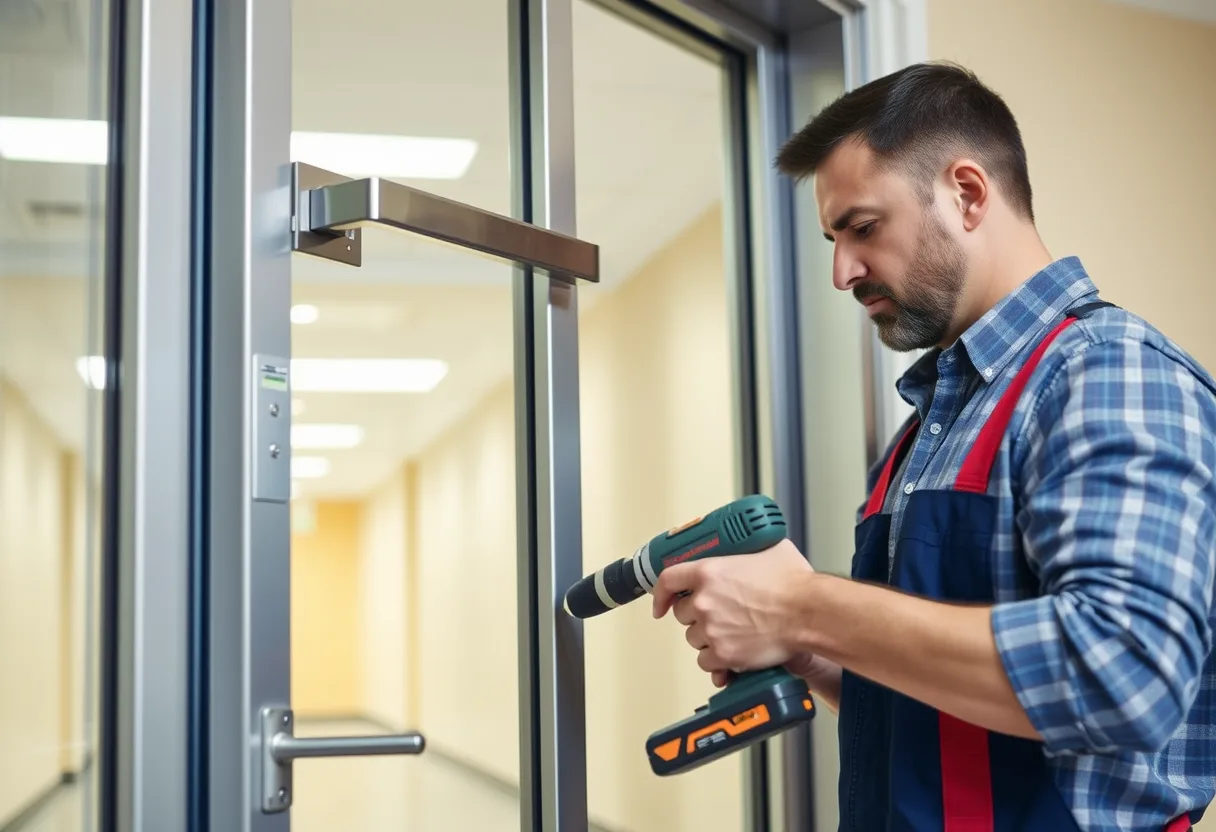
Push Bar Installation in Hancock Park, CA
Push bars, panic bars, and crash bars installed on commercial doors — code-compliant exit devices fitted to the door, not forced onto it. Local technicians, free estimates, and same-day response in Hancock Park.
Most entry problems don't announce themselves — they accumulate quietly until something goes wrong. At Access Controls LA, push bar installation in Hancock Park isn't a side offering — it's the core of what our technicians train on, stock parts for, and stand behind. Reach us at (888) 897-8860 seven days a week during business hours; most estimates are scheduled within a day.
Push Bar Installation for Hancock Park Properties
No two service areas are alike, and Hancock Park proves it. In Hancock Park's older buildings, we routinely reuse sound legacy wiring and choose hardware that doesn't require butchering a 1920s door to mount.
Much of Hancock Park is residential streets where our work looks different: driveway gates, keyless front entries, and systems that family members of every age can actually use.
Our Hancock Park clients at the higher end of the market want security without visual clutter; we design systems that are felt, not seen.
We also keep notes on what we've installed around Hancock Park — door types, common panel locations, the quirks of the local building vintages — so follow-up calls and new projects start ahead instead of from scratch.
How Push Bar Installation Is Done Right
Anyone can mount a reader. The craft is in everything you can't see once the cover goes on. On every job, exit devices are life-safety hardware: rim, mortise, and vertical-rod devices each suit different doors and pairs, and the wrong type fails inspection. Before we call it finished, ADA requires exits to operate with a single motion and limited force, and we verify both with a gauge before handoff. Done properly, fire-rated openings require fire-exit hardware — a standard panic bar on a rated door voids its label.
Before we call it finished, the device is sized and cut to the door, with through-bolts and reinforcement where hollow metal or aluminum needs it. We make sure outside trim — lever, pull, or keyed — is chosen separately from the bar, which is how a door stays exit-always while entry stays controlled.
The Situations We Fix Most
The calls we get about this tend to rhyme. A few of the most common:
- An exit-only door that staff keep propping because it has no outside entry.
- A glass or aluminum storefront door that needs a code-legal exit.
- A fire marshal citation for a missing or non-compliant exit device.
- Double doors that need panic hardware without a center mullion.
Every one of these has a hardware answer that costs less than living with the problem for another year.
Where We Install It
We've installed this for just about every property type, though a few come up constantly — retail stores, churches, office buildings, schools, among others.
Each environment changes the spec — mounting heights, weather exposure, door materials, traffic volume — which is exactly why we survey before we quote. Duty cycle is the quiet variable: a door that cycles forty times a day and one that cycles four hundred need different hardware grades, even if they look identical in a catalog.
How to Think About the Equipment
The credential question — keypad codes, cards, fobs, phones, or biometrics — gets more attention than it deserves, and the infrastructure questions get less. What decides the spec is duty cycle, weather exposure, door construction, and who answers when something goes wrong — not the brochure. When the technology fits the property, the system disappears into the routine; when it doesn't, it becomes everyone's least favorite coworker.
A decade of reliable service is designed in at the start, in choices that never show up in a photo. We favor equipment with a long parts tail and an open ecosystem, because the cheapest proprietary system becomes the most expensive one the day its manufacturer loses interest. Finally, insist that whatever gets installed leaves documentation behind. The cheapest system with labeled wiring outlives the premium one that's a mystery to the next technician.
How the Work Unfolds
1. The Assessment Visit
First visit is diagnostic, not sales. We inspect the doors and gates in question, test any existing equipment worth saving, and map cable paths and panel locations. By the end of the walkthrough you'll know the realistic options, roughly what each costs, and which one we'd choose if it were our building.
2. Scope, Spec, and Price
We design the system around how the property actually operates: who needs access, when, and through which doors. The proposal names exact hardware — not 'reader, qty 4' but the specific model and why. Options are priced as options, so good-better-best is your decision, made with real numbers.
3. Clean, Scheduled Installation
We treat installation as finish carpentry, not rough construction. Readers mount level at ADA-compliant heights, strikes and maglocks align precisely so they hold full rated force, and penetrations get sealed. Every wire lands labeled at a documented panel — the kind of detail you appreciate three years later during a service call.
4. Commissioning and Training
Commissioning means testing every door the hard way: real credentials at the reader, lock engagement under load, request-to-exit timing, door position reporting, and alarm events confirmed end to end. Then we train your people — enrolling and revoking credentials, changing schedules, running reports — until they're comfortable driving the system themselves.
5. Ongoing Service
We stand behind the work: workmanship is warranted, hardware carries manufacturer coverage we actually help you claim, and our service desk knows your site when you call. Properties that want zero surprises put the system on a maintenance plan; everyone else just saves our number.
What Makes Us Different
There's no shortage of companies that will sell you hardware. Here's what you actually hire when you call us:
- Long hours, real humans. The phone at (888) 897-8860 is answered Sunday through Thursday 6:30am to 11:30pm and Friday until 4pm — by dispatchers who schedule, not a voicemail tree.
- Repairs before replacements. If your existing system can be fixed economically, that's what we'll tell you — a reputation outlasts any single invoice.
- Fixed quotes that hold. The number we put in writing is the number on the invoice unless you change the scope.
- Documentation left behind. Labeled wiring, panel maps, and credentials records stay with the property — you're never hostage to whoever installed the system.
- Code-first installs. Egress, fire alarm tie-ins, and ADA requirements are engineered into every quote — never discovered by an inspector afterward.
Our schedule is built around the reality that entries fail at inconvenient times — reach us Sunday–Thursday from 6:30am to 11:30pm, and Fridays until 4pm.
Pricing: What Actually Moves the Number
Pricing for push bar installation in Hancock Park isn't a mystery — it's arithmetic driven by a handful of site factors.
- Whether existing cabling and hardware can be reused after testing.
- The credential technology chosen, from basic keypads to encrypted cards to mobile.
- Wiring distance and pathway difficulty between doors, panels, and power.
- The number of openings being controlled, since each door or gate carries its own hardware and labor.
- Code requirements at each opening — exit devices, fire alarm tie-ins, and ADA operators where applicable.
The honest path is a short site visit, after which the quote is fixed and itemized. If a cheaper configuration would serve you fine, the quote will say so.
The Searches That Lead Here
Property owners describe this need in wildly different words. These searches all land on the same answer:
- Panic bar installation near me
- Push bar door alarm
- Panic bar installer near me
- Crash bar installation near me
- Commercial push bar door installation
- Electric push bar installation — Central Los Angeles
- Alarm exit device in Hancock Park
- Exit device installation — Central Los Angeles
The vocabulary varies, the solution doesn't — a proper survey, a fixed quote, and hardware installed to code anywhere in Central Los Angeles. Start at (888) 897-8860.
What Happens When You Call
The call to (888) 897-8860 is shorter than you expect: what's the property, what's the door or gate doing, and when can we look at it. Have nothing prepared; our questions do the work. Within a few minutes we'll know whether you need a repair visit, a survey for new equipment, or honest advice to do nothing yet.
Estimates are free, windows are honored, and the person quoting is accountable for the result — a sequence that shouldn't be remarkable in this trade, but is.
Also Serving the Area Around Hancock Park
Our trucks work out of Van Nuys and cover all of Los Angeles County, so Hancock Park jobs are routine — as are calls from Los Angeles, West Hollywood, Baldwin Hills, Chinatown, Crenshaw, Downtown Los Angeles, and every community in between.
Push Bar Installation in Hancock Park — FAQs
What brands do you install and service?
Can parts of my old system be kept?
Can I manage it myself after you leave?
Can you work on a system another company installed?
Are you licensed and insured?
Do you give free estimates?
What happens to the system when power fails?
Do you cover all of Los Angeles County?
Does this integrate with other building systems?
Do you offer maintenance plans?
Push Bar Installation in Nearby Cities
More Services in Hancock Park
- Magnetic Lock Installation Hancock Park
- Magnetic Lock Repair Hancock Park
- Magnetic Lock Replacement Hancock Park
- Electric Strike Installation Hancock Park
- Electrified Door Hardware Hancock Park
- Push Bar Repair Hancock Park
- Access Control Installation Hancock Park
- Commercial Access Control Hancock Park
- Key Card Entry Systems Hancock Park
- Key Fob Entry Systems Hancock Park
- Keypad Entry Systems Hancock Park
- Mobile Access Control Hancock Park
Push Bar Installation in Hancock Park — Handled
Call (888) 897-8860 for a free on-site estimate anywhere in Hancock Park.