
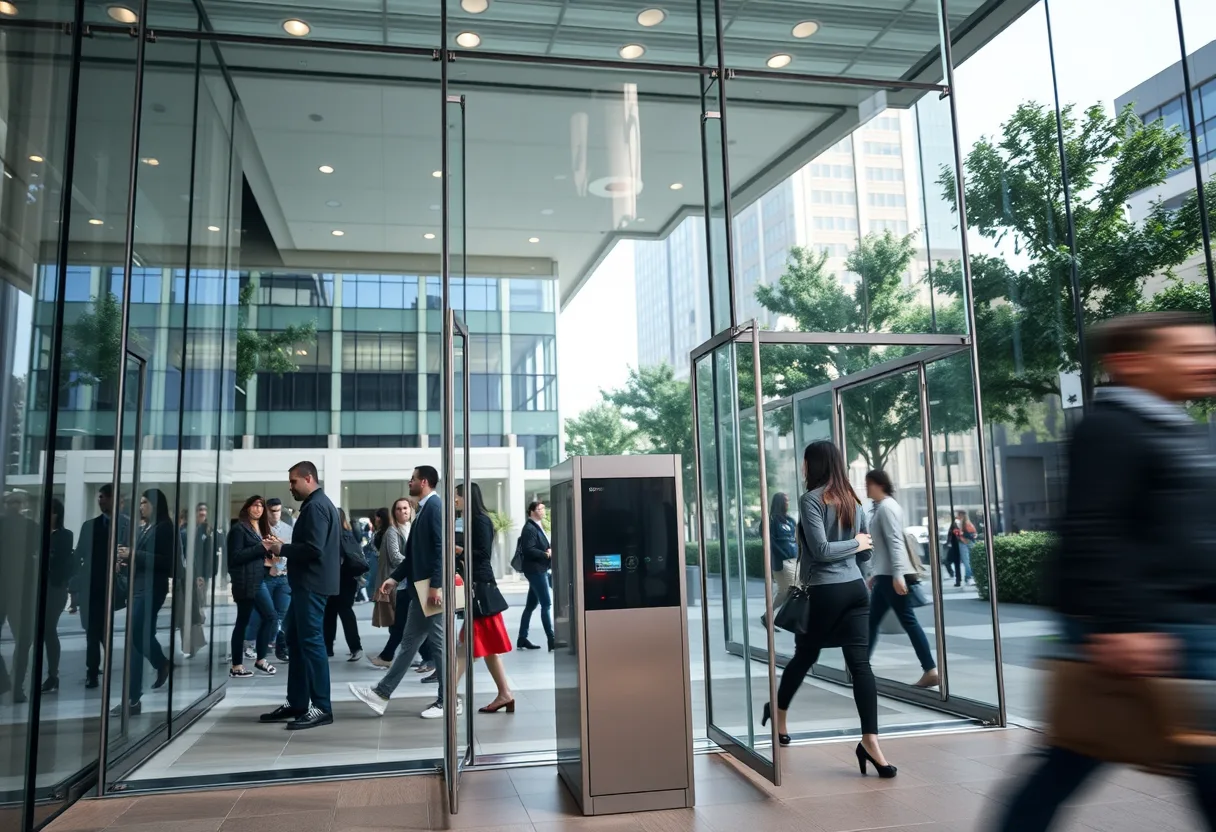
Storefront Access Control in Los Angeles
Locking hardware and readers engineered for glass and aluminum storefront doors.
There's a moment every property owner recognizes: the day they stop trusting who might still have a key. Our team at Access Controls LA has built its reputation on storefront access control done right the first time — clean wiring, code-compliant hardware, and documentation left on site. If you'd rather talk than read, (888) 897-8860 reaches our dispatch desk from early morning until late evening.
What Storefront Access Control Covers
Locking hardware and readers engineered for glass and aluminum storefront doors. Anyone can mount a reader. The craft is in everything you can't see once the cover goes on.
What Professional Commercial Access Control Involves
Anyone can mount a reader. The craft is in everything you can't see once the cover goes on. Before we call it finished, anti-passback and door-forced alarms stop credential sharing and tailgating. We make sure entry schedules unlock the front door during business hours and lock it tight after close. Our technicians see to it that audit trails show exactly which employee opened which door, down to the second.
Across hundreds of installs, one rule holds: individual credentials mean one terminated badge instead of rekeying the whole suite. Part of our discipline: glass storefront doors, aluminum frames, and hollow metal doors each take different locking hardware.
The Situations We Fix Most
These are the scenarios that fill our schedule:
- No way to give cleaning crews after-hours access without a master key.
- Doors left unlocked overnight.
- Shared PINs everyone knows.
- Former employees with keys that still work.
None of these get better on their own — and each one has a known, fixable cause that a proper assessment will surface in minutes.
Built for These Environments
You'll find our installs of this kind in retail stores, banks, restaurants, professional offices, and plenty of places in between.
The property dictates the hardware, never the other way around; what we install at an office entry is not what we bolt to a yard gate. Where the public touches the hardware, vandal resistance moves from option to requirement — sealed keypads, tamper switches, and fasteners that need more than a pocket screwdriver.
Choosing the Right Technology
Buyers tend to start with the gadget and work backward; installers who know better start with the opening and the people using it. What decides the spec is duty cycle, weather exposure, door construction, and who answers when something goes wrong — not the brochure. That's why our quotes name exact models with reasons attached, and why we'll talk you out of hardware you don't need as readily as we'll recommend what you do.
Most premature failures we're called to fix trace to one of three sins — undersized power, unsealed exterior hardware, or wiring that was never labeled. Ask any vendor one question: 'who else can service this?' The answer tells you whether you're buying a system or a dependency. One more lens worth applying: total cost over ten years, not the install invoice. Licensing, batteries, credential replacement, and service availability dwarf small hardware price differences over a system's life.
How the Work Unfolds
1. Site Survey & Assessment
Everything starts with eyes on the property. We check each opening's construction, trace what wiring already exists, verify power and network availability, and flag code considerations like egress requirements before anyone talks hardware. You get honest answers on site — including, sometimes, that you need less than you expected.
2. System Design and Quote
The design phase turns the survey into a bill of materials and a fixed price. Door schedules, credential types, power and wiring plans, and any code-required exit hardware are all specified in writing. You see the whole picture before committing a dollar.
3. Installation
On install day, the crew arrives with everything staged — hardware, brackets, cable, and the fasteners that match your door and frame materials. Doors stay operational as we work; a building is never left unsecured overnight. Wire runs are concealed where possible, protected where not, and labeled at both ends.
4. Programming & Commissioning
Commissioning means testing every door the hard way: real credentials at the reader, lock engagement under load, request-to-exit timing, door position reporting, and alarm events confirmed end to end. Then we train your people — enrolling and revoking credentials, changing schedules, running reports — until they're comfortable driving the system themselves.
5. Support After the Job
Systems live for years, and so does our relationship with them. We answer service calls for what we installed with real urgency — a locked-out business or a non-secure door is a same-day problem. Maintenance plans with scheduled testing, battery replacement, and firmware updates are available for properties that want failures caught before they happen.
Why Neighbors Keep Referring Us
After years of fixing other companies' installs, we built ours around a few commitments:
- Clean work, occupied buildings. Our crews are used to working around tenants, patients, and customers without turning your lobby into a construction site.
- Documentation left behind. Labeled wiring, panel maps, and credentials records stay with the property — you're never hostage to whoever installed the system.
- Local and present. We're based at 6100 Sepulveda Blvd in Van Nuys and work Los Angeles County daily — when something fails, the technician isn't driving in from another county.
- Specialists, not generalists. Access control, intercoms, buzzers, maglocks, and gates are all we do; we're not an alarm company moonlighting at your door hardware.
- Brand-agnostic advice. We install and service the major platforms, so the recommendation fits your building rather than a dealer quota.
We keep longer hours than nearly anyone in the trade: Sunday through Thursday 6:30am to 11:30pm and Friday 6:30am to 4pm. A door that fails at 9pm on a Tuesday doesn't wait for the next business day.
Cost Factors, Explained Plainly
Pricing for storefront access control isn't a mystery — it's arithmetic driven by a handful of site factors.
- Site conditions like occupied spaces, after-hours work windows, lifts for high mounting, or trenching at gates.
- The credential technology chosen, from basic keypads to encrypted cards to mobile.
- Software and licensing, which ranges from none (standalone) to per-door cloud subscriptions.
- Code requirements at each opening — exit devices, fire alarm tie-ins, and ADA operators where applicable.
- Wiring distance and pathway difficulty between doors, panels, and power.
After a walkthrough we quote one number, broken out by equipment and labor, and it holds. We'd rather lose a job on price than win it on surprises.
What People Type Before They Call
If any of these phrases brought you here, you're in the right place:
- Commercial access control systems — Los Angeles County
- Employee access control systems
- Storefront access control — Los Angeles County
- Retail store access control
- Access control for aluminum storefront doors
- Business access control systems
- Commercial access control installation in Los Angeles
- Office access control near me
However the search was worded, the destination is the same: a licensed local crew that does this exact work daily across Los Angeles County, reachable at (888) 897-8860.
From Phone Call to Fixed Door
The call to (888) 897-8860 is shorter than you expect: what's the property, what's the door or gate doing, and when can we look at it. If it's urgent — a door that won't lock, a gate stuck open — say so, and dispatch treats it as the same-day problem it is.
Estimates are free, windows are honored, and the person quoting is accountable for the result — a sequence that shouldn't be remarkable in this trade, but is.
Where We Work
Our trucks dispatch daily from Van Nuys and run routes through every region of Los Angeles County — the San Fernando Valley, the Westside, South Bay, the San Gabriel Valley, the Gateway Cities, Santa Clarita, the Antelope Valley, and the neighborhoods between them.
Distance never changes the price list, and there's no 'extended service area' surcharge. If the property sits in Los Angeles County, it's regular territory and quoted like it.
Storefront Access Control FAQs
Can parts of my old system be kept?
What payment and scheduling should I expect?
Do you cover all of Los Angeles County?
Do maglocks and controlled doors meet code?
Can the system connect to my cameras or alarm?
What's your response time in Los Angeles?
Do you give free estimates?
Will my staff be able to add and remove users?
Will the doors still work during a power outage?
More Commercial Access Control Services
- Commercial Access Control (overview)Business-grade access control for offices, storefronts, and commercial buildings of every size.
 Office Access ControlSuite entries, interior doors, server rooms, and after-hours access for office teams.
 Small Business Access ControlRight-sized one-to-four door systems that don't carry enterprise overhead.
 Multi-Location Access ControlOne cloud dashboard managing credentials across every branch and site.
 After-Hours Access ControlSchedules, holidays, and time-zoned permissions for round-the-clock operations.
Commercial Access Control Near You
- Commercial Access Control Arleta
- Commercial Access Control Burbank
- Commercial Access Control Calabasas
- Commercial Access Control Canoga Park
- Commercial Access Control Chatsworth
- Commercial Access Control Encino
- Commercial Access Control Glendale
- Commercial Access Control Granada Hills
- Commercial Access Control Hidden Hills
- Commercial Access Control Lake Balboa
- Commercial Access Control Lake View Terrace
- Commercial Access Control Mission Hills
- Commercial Access Control North Hills
- Commercial Access Control North Hollywood
- Commercial Access Control Northridge
- Commercial Access Control Pacoima
Related Services
Need Storefront Access Control?
Call (888) 897-8860 — free survey, fixed quote, fast scheduling anywhere in LA County.