Push Bar Installation in Woodland Hills, CA
Push bars, panic bars, and crash bars installed on commercial doors — code-compliant exit devices fitted to the door, not forced onto it. Local technicians, free estimates, and same-day response in Woodland Hills.
Keys get copied, codes get shared, and doors get propped — until the entry itself starts keeping score. Access Controls LA designs, installs, and services push bar installation in Woodland Hills with licensed low-voltage technicians who do this work every day. Reach us at (888) 897-8860 seven days a week during business hours; most estimates are scheduled within a day.
Push Bar Installation for Woodland Hills Properties
We've put in enough systems around Woodland Hills to know the patterns. Estates and high-end properties in Woodland Hills expect hardware that disappears into the architecture — flush readers, discreet intercoms, and finishes that match the doors they protect.
The office suites and commercial corridors in Woodland Hills run on tenant turnover, after-hours cleaning crews, and vendors who all need different levels of access — exactly the problem electronic credentials were built to solve.
Woodland Hills's retail strips lean on buzz-in entries, back-door delivery control, and stockroom credentials — small systems that pay for themselves in reduced shrinkage.
Beyond the property mix, geography shapes the work: Woodland Hills sits within San Fernando Valley, which means our crews are already routed through the area daily — there's no 'trip charge' territory in Los Angeles County, and no learning curve about local building stock.
What Separates Good Push Bar Installation From Guesswork
Anyone can mount a reader. The craft is in everything you can't see once the cover goes on. Non-negotiable for us: outside trim — lever, pull, or keyed — is chosen separately from the bar, which is how a door stays exit-always while entry stays controlled. You're paying a professional so that exit devices are life-safety hardware: rim, mortise, and vertical-rod devices each suit different doors and pairs, and the wrong type fails inspection. On every job, electrified latch retraction or alarm kits can be built in from day one, or added later if the device is specified right.
Before we call it finished, fire-rated openings require fire-exit hardware — a standard panic bar on a rated door voids its label. Before we call it finished, the device is sized and cut to the door, with through-bolts and reinforcement where hollow metal or aluminum needs it.
Problems This Solves
Here's what typically pushes a property from thinking about it to calling:
- Double doors that need panic hardware without a center mullion.
- A glass or aluminum storefront door that needs a code-legal exit.
- A fire marshal citation for a missing or non-compliant exit device.
- An exit-only door that staff keep propping because it has no outside entry.
The common thread: these are solved problems. The hardware exists, it's proven, and it's less expensive than it was five years ago.
Built for These Environments
We've installed this for just about every property type, though a few come up constantly — churches, warehouses, retail stores, schools, among others.
Each environment changes the spec — mounting heights, weather exposure, door materials, traffic volume — which is exactly why we survey before we quote. Duty cycle is the quiet variable: a door that cycles forty times a day and one that cycles four hundred need different hardware grades, even if they look identical in a catalog.
Getting the Hardware Decision Right
The credential question — keypad codes, cards, fobs, phones, or biometrics — gets more attention than it deserves, and the infrastructure questions get less. The right system for a property is the one its least technical daily user can operate and its busiest manager can administer without a support ticket. That's why our quotes name exact models with reasons attached, and why we'll talk you out of hardware you don't need as readily as we'll recommend what you do.
Longevity comes from boring places: supervised power with batteries that get tested, conductors sized for the run, hardware rated for the environment it lives in. Open standards matter too: systems built on common credential formats and standard wiring can be extended and serviced by anyone competent, not just the original vendor. It's also fair to ask how a system fails: well-designed entries degrade gracefully — doors stay secure, people stay safe, and the fix is a part, not a forklift.
What Working With Us Looks Like
1. Site Survey & Assessment
First visit is diagnostic, not sales. We inspect the doors and gates in question, test any existing equipment worth saving, and map cable paths and panel locations. By the end of the walkthrough you'll know the realistic options, roughly what each costs, and which one we'd choose if it were our building.
2. Design & Fixed Quote
You receive a written scope with specific hardware models, labor, and programming — one number, no allowances that balloon later. We explain why each component was chosen and what the alternatives would save or cost. The quote holds unless the scope changes, and you'll never learn about an exclusion after the deposit.
3. Installation
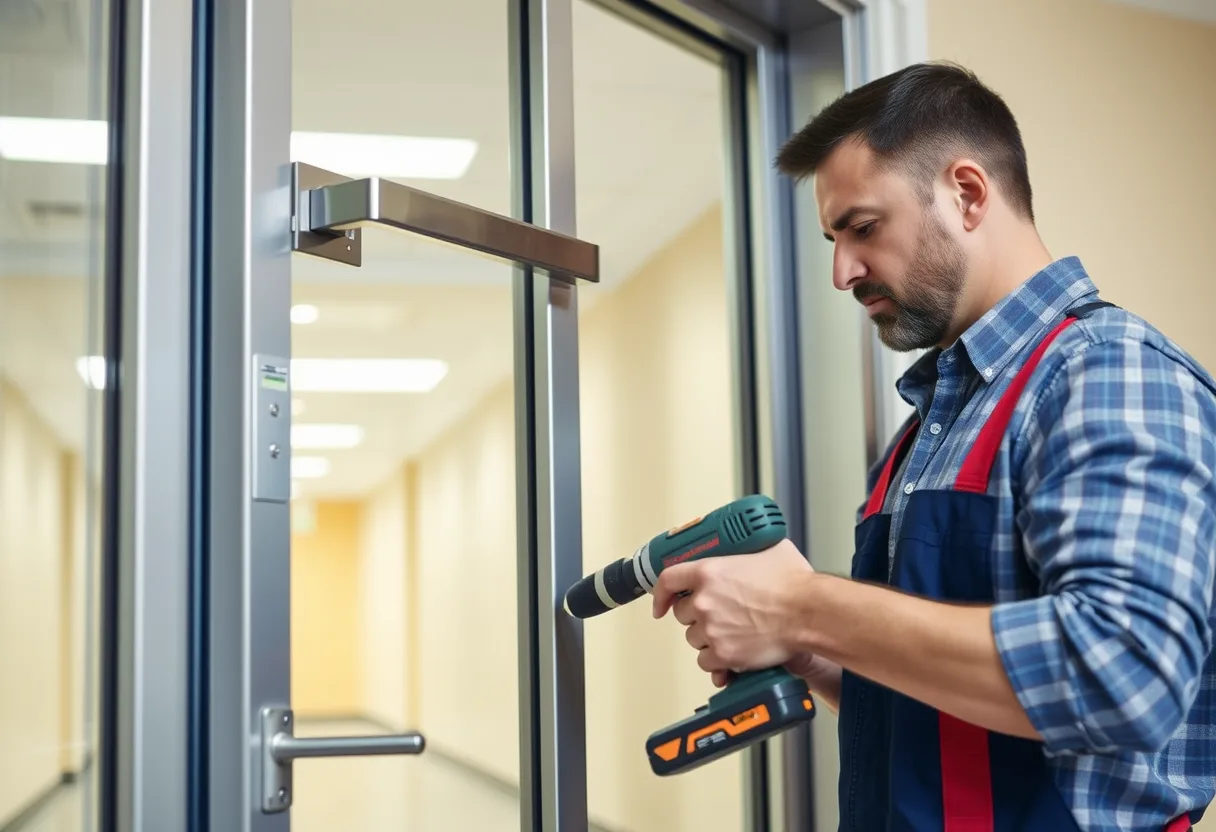
On install day, the crew arrives with everything staged — hardware, brackets, cable, and the fasteners that match your door and frame materials. Doors stay operational as we work; a building is never left unsecured overnight. Wire runs are concealed where possible, protected where not, and labeled at both ends.
4. Commissioning and Training
Before we call a job done, each opening passes a functional checklist: valid credential admits, invalid denies, egress is instant, propped and forced events report correctly. Schedules, holidays, and access levels get built with you at the keyboard so the logic matches reality. Documentation and as-builts stay on site.
5. Ongoing Service
We stand behind the work: workmanship is warranted, hardware carries manufacturer coverage we actually help you claim, and our service desk knows your site when you call. Properties that want zero surprises put the system on a maintenance plan; everyone else just saves our number.
What Makes Us Different
After years of fixing other companies' installs, we built ours around a few commitments:
- Clean work, occupied buildings. Our crews are used to working around tenants, patients, and customers without turning your lobby into a construction site.
- Fixed quotes that hold. The number we put in writing is the number on the invoice unless you change the scope.
- Specialists, not generalists. Access control, intercoms, buzzers, maglocks, and gates are all we do; we're not an alarm company moonlighting at your door hardware.
- Documentation left behind. Labeled wiring, panel maps, and credentials records stay with the property — you're never hostage to whoever installed the system.
- Code-first installs. Egress, fire alarm tie-ins, and ADA requirements are engineered into every quote — never discovered by an inspector afterward.
We keep longer hours than nearly anyone in the trade: Sunday through Thursday 6:30am to 11:30pm and Friday 6:30am to 4pm. A door that fails at 9pm on a Tuesday doesn't wait for the next business day.
Cost Factors, Explained Plainly
Nobody can quote push bar installation in Woodland Hills accurately sight-unseen, and anyone who does is planning change orders. What we can do is tell you what moves the price.
- Whether existing cabling and hardware can be reused after testing.
- Software and licensing, which ranges from none (standalone) to per-door cloud subscriptions.
- Wiring distance and pathway difficulty between doors, panels, and power.
- Code requirements at each opening — exit devices, fire alarm tie-ins, and ADA operators where applicable.
- The credential technology chosen, from basic keypads to encrypted cards to mobile.
The honest path is a short site visit, after which the quote is fixed and itemized. If a cheaper configuration would serve you fine, the quote will say so.
The Searches That Lead Here
If any of these phrases brought you here, you're in the right place:
- Crash bar for commercial door
- Crash bar installation
- Panic hardware installation in Woodland Hills
- Exit device installation — San Fernando Valley
- Electric latch retraction push bar
- Alarmed panic bar installation (Woodland Hills, CA)
- Push bar installation — San Fernando Valley
- Panic bar installer near me — San Fernando Valley
The vocabulary varies, the solution doesn't — a proper survey, a fixed quote, and hardware installed to code anywhere in San Fernando Valley. Start at (888) 897-8860.
What Happens When You Call
The call to (888) 897-8860 is shorter than you expect: what's the property, what's the door or gate doing, and when can we look at it. Describe what you're seeing in plain terms — 'the buzzer rings but the door won't open,' 'we need fobs for a new office,' 'the gate keypad died' — and we'll usually identify the likely cause and the fix on the spot.
No pressure tactics, no 'today-only' pricing — just a diagnosis, a number in writing, and a schedule that respects yours.
Also Serving the Area Around Woodland Hills
Woodland Hills is one stop on routes that also take us through Arleta, Burbank, Calabasas, Canoga Park, Chatsworth, Encino — same technicians, same response standards, county-wide.
Push Bar Installation in Woodland Hills — FAQs
How long does installation take?
Do maglocks and controlled doors meet code?
Do I have to replace everything, or can you reuse existing wiring?
What ongoing support is available?
Can the system connect to my cameras or alarm?
Do you cover all of Los Angeles County?
Is my aging system worth fixing?
What brands do you install and service?
Are you licensed and insured?
What payment and scheduling should I expect?
Push Bar Installation in Nearby Cities
More Services in Woodland Hills
- Magnetic Lock Installation Woodland Hills
- Magnetic Lock Repair Woodland Hills
- Magnetic Lock Replacement Woodland Hills
- Electric Strike Installation Woodland Hills
- Electrified Door Hardware Woodland Hills
- Push Bar Repair Woodland Hills
- Access Control Installation Woodland Hills
- Commercial Access Control Woodland Hills
- Key Card Entry Systems Woodland Hills
- Key Fob Entry Systems Woodland Hills
- Keypad Entry Systems Woodland Hills
- Mobile Access Control Woodland Hills
Push Bar Installation in Woodland Hills — Handled
Call (888) 897-8860 for a free on-site estimate anywhere in Woodland Hills.