Push Bar Installation in Long Beach, CA
Push bars, panic bars, and crash bars installed on commercial doors — code-compliant exit devices fitted to the door, not forced onto it. Local technicians, free estimates, and same-day response in Long Beach.
The difference between a secured building and a hopeful one usually comes down to what's mounted beside the door. That's exactly the work Access Controls LA does: professional push bar installation in Long Beach, engineered for the property in front of us rather than copied from the last job. Call (888) 897-8860 and a real technician — not a call center — will talk through your doors, your gates, and what they actually need.
Push Bar Installation for Long Beach Properties
Local conditions shape every spec we write in Long Beach. The denser blocks of Long Beach mean mixed-use buildings, shared lobbies, and parking structures — systems here coordinate several entry types under one credential database.
Long Beach's commercial buildings juggle multiple tenants behind shared entries, which is why we see so much demand there for suite-level credentials layered over building-level schedules.
Near the port-adjacent zones of Long Beach, access work skews heavy-duty: yard gates, driver credentialing, and hardware that survives marine air and industrial traffic.
Permitting, egress code, and fire-alarm tie-in requirements apply in Long Beach exactly as they do county-wide, and our installs are engineered to pass inspection the first time, every time.
How Push Bar Installation Is Done Right
Anyone can mount a reader. The craft is in everything you can't see once the cover goes on. It matters that the device is sized and cut to the door, with through-bolts and reinforcement where hollow metal or aluminum needs it. Before we call it finished, electrified latch retraction or alarm kits can be built in from day one, or added later if the device is specified right. Experience shows up in details like this: outside trim — lever, pull, or keyed — is chosen separately from the bar, which is how a door stays exit-always while entry stays controlled.
You're paying a professional so that exit devices are life-safety hardware: rim, mortise, and vertical-rod devices each suit different doors and pairs, and the wrong type fails inspection. Our technicians see to it that ADA requires exits to operate with a single motion and limited force, and we verify both with a gauge before handoff. Before we call it finished, fire-rated openings require fire-exit hardware — a standard panic bar on a rated door voids its label.
The Situations We Fix Most
If any of these sound like your property, you're squarely in our wheelhouse:
- A glass or aluminum storefront door that needs a code-legal exit.
- Double doors that need panic hardware without a center mullion.
- A fire marshal citation for a missing or non-compliant exit device.
- An exit-only door that staff keep propping because it has no outside entry.
Every one of these has a hardware answer that costs less than living with the problem for another year.
Built for These Environments
The usual homes for this hardware: schools, office buildings, warehouses, assembly spaces.
Different buildings stress hardware differently, so the same service can mean meaningfully different equipment choices from one property to the next. Exterior installs get an extra layer of scrutiny — gaskets, drip protection, UV-stable housings, and conduit where cable would otherwise bake or flood.
Getting the Hardware Decision Right
Buyers tend to start with the gadget and work backward; installers who know better start with the opening and the people using it. The right system for a property is the one its least technical daily user can operate and its busiest manager can administer without a support ticket. That's why our quotes name exact models with reasons attached, and why we'll talk you out of hardware you don't need as readily as we'll recommend what you do.
A decade of reliable service is designed in at the start, in choices that never show up in a photo. We favor equipment with a long parts tail and an open ecosystem, because the cheapest proprietary system becomes the most expensive one the day its manufacturer loses interest. Resist the urge to over-buy, too. Half our value on a survey is naming what a property doesn't need — features that demo well and then sit unused for a decade.
From First Call to Finished System
1. Site Survey & Assessment
A technician walks the property with you — every controlled opening, the door and frame materials, existing wiring, power availability, and network access. We photograph, measure, and note the things that bite installs later: fire-rated doors, ADA clearances, panel locations, cable paths. The survey is free, takes under an hour for most properties, and ends with you knowing what's actually feasible.
2. System Design and Quote
The design phase turns the survey into a bill of materials and a fixed price. Door schedules, credential types, power and wiring plans, and any code-required exit hardware are all specified in writing. You see the whole picture before committing a dollar.
3. Clean, Scheduled Installation
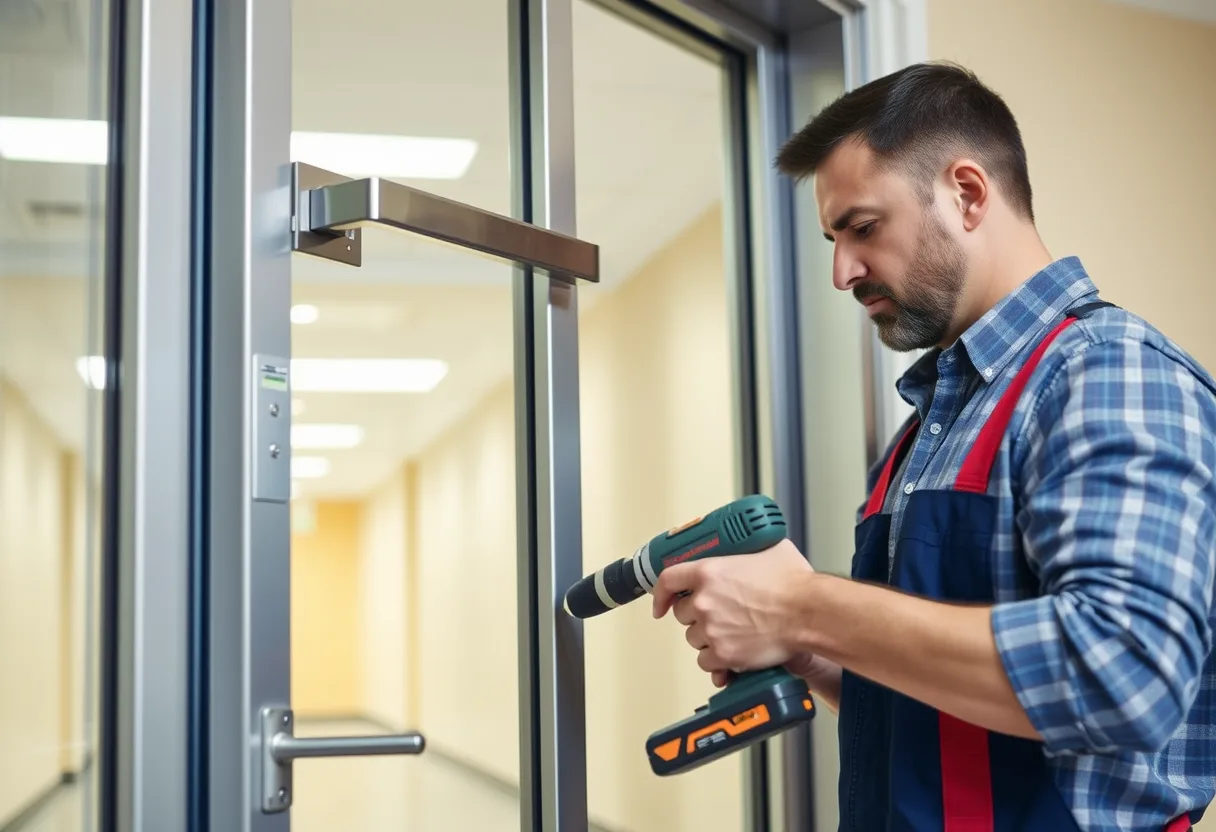
Installation is scheduled around your operation — occupied offices, tenant buildings, and storefronts each get a plan that keeps doors functional through the workday. Our technicians drill clean, pull and label every conductor, mount hardware level and square, and leave the site cleaner than they found it. No borrowed subcontractors; the people who quoted are the people who answer for the work.
4. Setup, Testing, and Handoff
The handoff is where many installers vanish; it's where we slow down. We commission door by door, tune alarm thresholds so staff don't learn to ignore them, and set up your administrators with their own logins and a cheat sheet for the five tasks they'll actually do. You shouldn't need us to add a new hire.
5. Support After the Job
Systems live for years, and so does our relationship with them. We answer service calls for what we installed with real urgency — a locked-out business or a non-secure door is a same-day problem. Maintenance plans with scheduled testing, battery replacement, and firmware updates are available for properties that want failures caught before they happen.
Why Neighbors Keep Referring Us
There's no shortage of companies that will sell you hardware. Here's what you actually hire when you call us:
- Local and present. We're based at 6100 Sepulveda Blvd in Van Nuys and work the Gateway Cities daily — when something fails, the technician isn't driving in from another county.
- Repairs before replacements. If your existing system can be fixed economically, that's what we'll tell you — a reputation outlasts any single invoice.
- Documentation left behind. Labeled wiring, panel maps, and credentials records stay with the property — you're never hostage to whoever installed the system.
- Fixed quotes that hold. The number we put in writing is the number on the invoice unless you change the scope.
- Specialists, not generalists. Access control, intercoms, buzzers, maglocks, and gates are all we do; we're not an alarm company moonlighting at your door hardware.
Call windows most companies won't match: 6:30am to 11:30pm Sunday through Thursday, 6:30am to 4pm Friday. Same-day response is the norm for non-secure doors, not a premium service.
Understanding the Investment
Nobody can quote push bar installation in Long Beach accurately sight-unseen, and anyone who does is planning change orders. What we can do is tell you what moves the price.
- Site conditions like occupied spaces, after-hours work windows, lifts for high mounting, or trenching at gates.
- Whether existing cabling and hardware can be reused after testing.
- Code requirements at each opening — exit devices, fire alarm tie-ins, and ADA operators where applicable.
- Software and licensing, which ranges from none (standalone) to per-door cloud subscriptions.
- Wiring distance and pathway difficulty between doors, panels, and power.
A survey pins all of this down and produces a fixed quote — typically within a day of the visit. The assessment costs nothing and obligates you to nothing.
One Service, Many Search Terms
The phone rings from all of these searches — different words, identical job:
- Commercial push bar door installation (Long Beach, CA)
- Push bar installation — the Gateway Cities
- Panic bar installer near me (Long Beach, CA)
- Electric latch retraction push bar
- Commercial panic bar installation in Long Beach
- Push bar installation cost in Long Beach
- Storefront push bar installation (Long Beach, CA)
- Panic hardware installation
However the search was worded, the destination is the same: a licensed local crew that does this exact work daily across the Gateway Cities, reachable at (888) 897-8860.
From Phone Call to Fixed Door
When you dial (888) 897-8860, you're talking to the same local operation that will send the technician — no national call center, no lead reselling. If it's urgent — a door that won't lock, a gate stuck open — say so, and dispatch treats it as the same-day problem it is.
From there it's a confirmed window, a technician who shows up inside it, and a written outcome: either the fix completed or a fixed quote for the work.
Also Serving the Area Around Long Beach
If your property sits outside Long Beach proper, you're still covered: we regularly serve Artesia, Bell, Bell Gardens, Bellflower, Cerritos, Commerce, and the rest of the Gateway Cities.
Push Bar Installation in Long Beach — FAQs
Is this legal for my doors? What about fire code?
What ongoing support is available?
Can the system connect to my cameras or alarm?
My original installer disappeared — can you take over?
Do I have to replace everything, or can you reuse existing wiring?
Will my staff be able to add and remove users?
My system is old — repair or replace?
How disruptive is the install?
Do you cover all of Los Angeles County?
Who actually shows up — employees or subs?
Push Bar Installation in Nearby Cities
More Services in Long Beach
- Magnetic Lock Installation Long Beach
- Magnetic Lock Repair Long Beach
- Magnetic Lock Replacement Long Beach
- Electric Strike Installation Long Beach
- Electrified Door Hardware Long Beach
- Push Bar Repair Long Beach
- Access Control Installation Long Beach
- Commercial Access Control Long Beach
- Key Card Entry Systems Long Beach
- Key Fob Entry Systems Long Beach
- Keypad Entry Systems Long Beach
- Mobile Access Control Long Beach
Push Bar Installation in Long Beach — Handled
Call (888) 897-8860 for a free on-site estimate anywhere in Long Beach.