
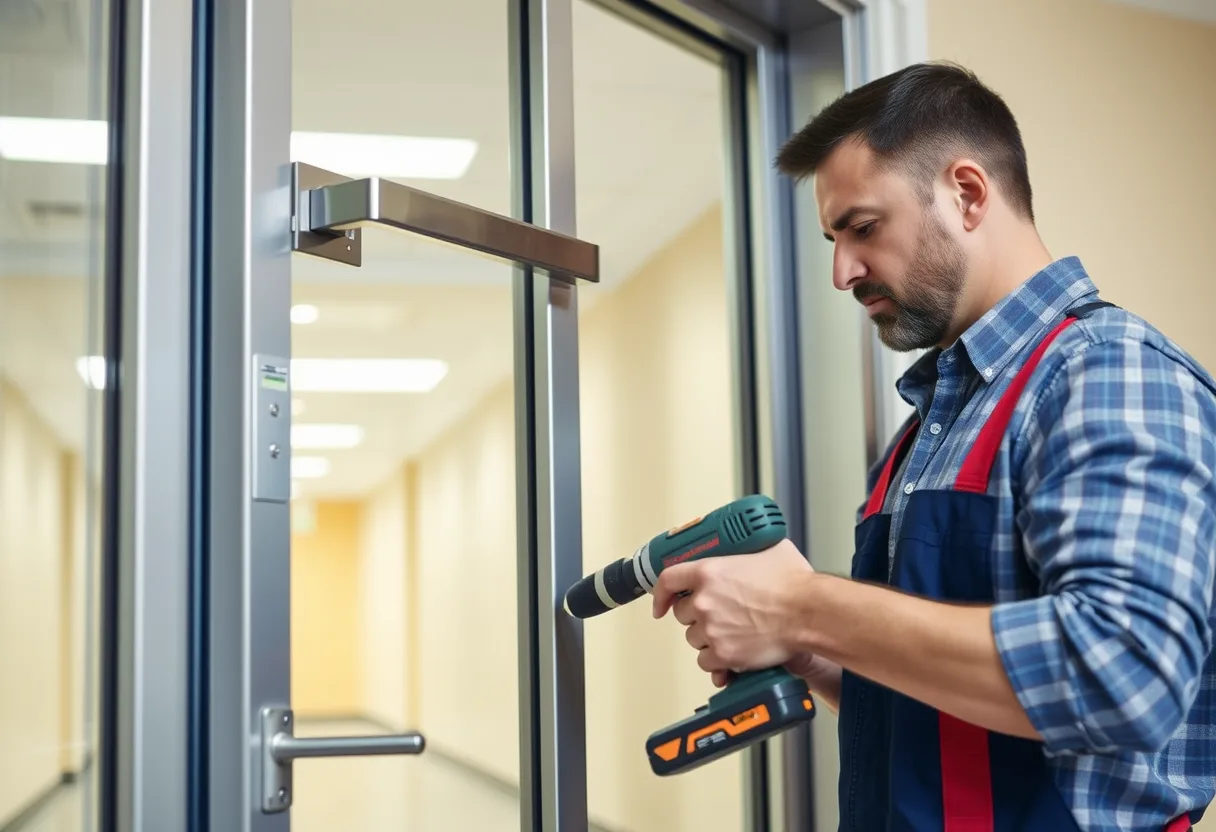
Push Bar Installation in Diamond Bar, CA
Push bars, panic bars, and crash bars installed on commercial doors — code-compliant exit devices fitted to the door, not forced onto it. Local technicians, free estimates, and same-day response in Diamond Bar.
An entrance either controls access or it merely suggests it. Access Controls LA handles push bar installation in Diamond Bar end to end — survey, hardware, wiring, programming, and the follow-up support that keeps it working. One call to (888) 897-8860 gets you straight answers, a free assessment, and a quote that doesn't change after the work starts.
Push Bar Installation for Diamond Bar Properties
The properties we service in Diamond Bar share some clear patterns. Diamond Bar's commercial buildings juggle multiple tenants behind shared entries, which is why we see so much demand there for suite-level credentials layered over building-level schedules.
Gated communities in and around Diamond Bar bring their own checklist — resident lanes that don't stack traffic, visitor entry that residents approve from a phone, and vendor windows the board can actually audit.
Homeowners in Diamond Bar typically call us for keyless entry and gate access that ends the hidden-key, shared-code routine without turning the house into a fortress.
Beyond the property mix, geography shapes the work: Diamond Bar sits within the San Gabriel Valley, which means our crews are already routed through the area daily — there's no 'trip charge' territory in Los Angeles County, and no learning curve about local building stock.
The Standards Behind Our Push Bar Installation
A few non-negotiables define how we work, whatever the size of the job. It matters that exit devices are life-safety hardware: rim, mortise, and vertical-rod devices each suit different doors and pairs, and the wrong type fails inspection. Part of our discipline: the device is sized and cut to the door, with through-bolts and reinforcement where hollow metal or aluminum needs it. On every job, fire-rated openings require fire-exit hardware — a standard panic bar on a rated door voids its label.
It matters that outside trim — lever, pull, or keyed — is chosen separately from the bar, which is how a door stays exit-always while entry stays controlled. Done properly, ADA requires exits to operate with a single motion and limited force, and we verify both with a gauge before handoff.
Problems This Solves
If any of these sound like your property, you're squarely in our wheelhouse:
- An exit-only door that staff keep propping because it has no outside entry.
- A glass or aluminum storefront door that needs a code-legal exit.
- Double doors that need panic hardware without a center mullion.
- A fire marshal citation for a missing or non-compliant exit device.
The common thread: these are solved problems. The hardware exists, it's proven, and it's less expensive than it was five years ago.
Typical Properties and Placements
We've installed this for just about every property type, though a few come up constantly — warehouses, restaurants, office buildings, assembly spaces, among others.
The property dictates the hardware, never the other way around; what we install at an office entry is not what we bolt to a yard gate. Exterior installs get an extra layer of scrutiny — gaskets, drip protection, UV-stable housings, and conduit where cable would otherwise bake or flood.
Getting the Hardware Decision Right
Buyers tend to start with the gadget and work backward; installers who know better start with the opening and the people using it. What decides the spec is duty cycle, weather exposure, door construction, and who answers when something goes wrong — not the brochure. Our job in the design phase is translating those realities into equipment — and being accountable for the translation years later.
Most premature failures we're called to fix trace to one of three sins — undersized power, unsealed exterior hardware, or wiring that was never labeled. We favor equipment with a long parts tail and an open ecosystem, because the cheapest proprietary system becomes the most expensive one the day its manufacturer loses interest. One more lens worth applying: total cost over ten years, not the install invoice. Licensing, batteries, credential replacement, and service availability dwarf small hardware price differences over a system's life.
Our Process, Step by Step
1. Walkthrough and Survey
First visit is diagnostic, not sales. We inspect the doors and gates in question, test any existing equipment worth saving, and map cable paths and panel locations. By the end of the walkthrough you'll know the realistic options, roughly what each costs, and which one we'd choose if it were our building.
2. Design & Fixed Quote
You receive a written scope with specific hardware models, labor, and programming — one number, no allowances that balloon later. We explain why each component was chosen and what the alternatives would save or cost. The quote holds unless the scope changes, and you'll never learn about an exclusion after the deposit.
3. The Install
On install day, the crew arrives with everything staged — hardware, brackets, cable, and the fasteners that match your door and frame materials. Doors stay operational as we work; a building is never left unsecured overnight. Wire runs are concealed where possible, protected where not, and labeled at both ends.
4. Setup, Testing, and Handoff
Before we call a job done, each opening passes a functional checklist: valid credential admits, invalid denies, egress is instant, propped and forced events report correctly. Schedules, holidays, and access levels get built with you at the keyboard so the logic matches reality. Documentation and as-builts stay on site.
5. What Happens After We Leave
Systems live for years, and so does our relationship with them. We answer service calls for what we installed with real urgency — a locked-out business or a non-secure door is a same-day problem. Maintenance plans with scheduled testing, battery replacement, and firmware updates are available for properties that want failures caught before they happen.
Why Neighbors Keep Referring Us
There's no shortage of companies that will sell you hardware. Here's what you actually hire when you call us:
- Code-first installs. Egress, fire alarm tie-ins, and ADA requirements are engineered into every quote — never discovered by an inspector afterward.
- Clean work, occupied buildings. Our crews are used to working around tenants, patients, and customers without turning your lobby into a construction site.
- Long hours, real humans. The phone at (888) 897-8860 is answered Sunday through Thursday 6:30am to 11:30pm and Friday until 4pm — by dispatchers who schedule, not a voicemail tree.
- One accountable team. Survey, quote, install, program, and support come from the same company — no finger-pointing between a salesman, a sub, and a help desk.
- Documentation left behind. Labeled wiring, panel maps, and credentials records stay with the property — you're never hostage to whoever installed the system.
Our schedule is built around the reality that entries fail at inconvenient times — reach us Sunday–Thursday from 6:30am to 11:30pm, and Fridays until 4pm.
Cost Factors, Explained Plainly
Nobody can quote push bar installation in Diamond Bar accurately sight-unseen, and anyone who does is planning change orders. What we can do is tell you what moves the price.
- Whether existing cabling and hardware can be reused after testing.
- The credential technology chosen, from basic keypads to encrypted cards to mobile.
- Software and licensing, which ranges from none (standalone) to per-door cloud subscriptions.
- Code requirements at each opening — exit devices, fire alarm tie-ins, and ADA operators where applicable.
- Site conditions like occupied spaces, after-hours work windows, lifts for high mounting, or trenching at gates.
The honest path is a short site visit, after which the quote is fixed and itemized. If a cheaper configuration would serve you fine, the quote will say so.
One Service, Many Search Terms
The phone rings from all of these searches — different words, identical job:
- Push bar door lock installation near me
- Fire rated panic bar installation
- Push bar door alarm — the San Gabriel Valley
- Commercial panic bar installation — the San Gabriel Valley
- Panic bar installer near me
- Crash bar installation
- Push bar with access control in Diamond Bar
- Electric push bar installation
The vocabulary varies, the solution doesn't — a proper survey, a fixed quote, and hardware installed to code anywhere in the San Gabriel Valley. Start at (888) 897-8860.
Your First Call, Demystified
When you dial (888) 897-8860, you're talking to the same local operation that will send the technician — no national call center, no lead reselling. Have nothing prepared; our questions do the work. Within a few minutes we'll know whether you need a repair visit, a survey for new equipment, or honest advice to do nothing yet.
Estimates are free, windows are honored, and the person quoting is accountable for the result — a sequence that shouldn't be remarkable in this trade, but is.
Nearby Communities We Cover
If your property sits outside Diamond Bar proper, you're still covered: we regularly serve Alhambra, Arcadia, Azusa, Baldwin Park, Bradbury, City of Industry, and the rest of the San Gabriel Valley.
Push Bar Installation in Diamond Bar — FAQs
What happens to the system when power fails?
Do maglocks and controlled doors meet code?
Do I have to replace everything, or can you reuse existing wiring?
Does this integrate with other building systems?
Will my staff be able to add and remove users?
How disruptive is the install?
Are you tied to one manufacturer?
Do you offer maintenance plans?
My system is old — repair or replace?
Can you work on a system another company installed?
Push Bar Installation in Nearby Cities
More Services in Diamond Bar
- Magnetic Lock Installation Diamond Bar
- Magnetic Lock Repair Diamond Bar
- Magnetic Lock Replacement Diamond Bar
- Electric Strike Installation Diamond Bar
- Electrified Door Hardware Diamond Bar
- Push Bar Repair Diamond Bar
- Access Control Installation Diamond Bar
- Commercial Access Control Diamond Bar
- Key Card Entry Systems Diamond Bar
- Key Fob Entry Systems Diamond Bar
- Keypad Entry Systems Diamond Bar
- Mobile Access Control Diamond Bar
Push Bar Installation in Diamond Bar — Handled
Call (888) 897-8860 for a free on-site estimate anywhere in Diamond Bar.